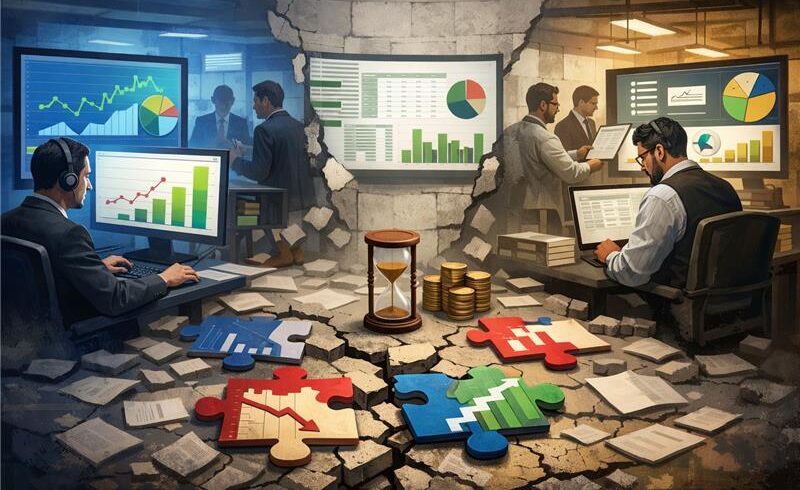
Modern organizations are surrounded by data. Dashboards update constantly. Reports arrive every day. Spreadsheets track everything from revenue to inventory. On the surface, it seems like leaders have more information than ever before.
Yet when it’s time to make an important decision, many teams still hesitate. They ask for another report. Another validation. Another breakdown of the numbers.
That hesitation reveals the real issue. The problem isn’t the lack of data. It’s a lack of confidence in it.
This is the true difference between having data and having decision confidence.
Data shows the past. Confidence guides the next move.
Data answers important questions:
● What did we sell last month?
● Which products are profitable?
● How did costs change?
But decisions with confidence is different. It’s the assurance that the numbers are accurate, complete, and current, and that they clearly point to the next step.
Without that confidence, even the most advanced dashboards become passive tools. They inform, but they don’t drive action.
The hidden delay between insight and action
Many leaders recognize this scenario. A report shows margins declining. The numbers look concerning, but before anyone acts, questions start:
➤ Is this the latest data?
➤ Does it include all regions?
➤ Were there manual adjustments?
➤ Can operations confirm this?
What should have been a quick decision turns into meetings, reconciliations, and follow-ups. Days pass. Sometimes weeks.
By the time everyone agrees on the numbers, the business has already moved on. The issue has grown, or the opportunity has disappeared.
This quiet delay between insight and action exists in many organizations.
When the story is scattered across systems
One of the main reasons for low decision confidence is fragmented data.
● Finance works from ERP reports.
● Operations tracks production and inventory systems.
● Sales relies on CRM data.
Each team sees part of the truth, but not the whole story.
For example:
● Finance sees shrinking margins.
● Operations see rising material costs.
● Sales see increasing discounts.
Individually, these insights make sense. But without a connected view, leaders struggle to understand the cause and effect. Decisions become slower and less certain.
When financial and operational data are linked, the picture becomes clearer. Leaders can see how pricing, production, inventory, and customer behavior are affecting profitability in near real time. That clarity builds confidence.
Why backward-looking reports aren’t enough
Traditional reporting focuses on the past monthly close reports, quarterly reviews, and variance analyses. These explain what already happened.
That worked when markets moved slowly. It doesn’t work when costs, demand, and supply conditions change every week.
Leaders now need answers to forward-looking questions:
➣ Which customers may hurt margins next quarter?
➣ Where could cash get tight soon?
➣ Which products should we push or pause right now?
Predictive signals help answer these questions. They provide early warnings about what’s likely to happen next.
And when leaders see risks early, they act earlier and more confidently.
From reacting to shaping outcomes
Early visibility changes how decisions are made.
Instead of discovering at month-end that a product line is unprofitable, teams can see the trend weeks earlier. Instead of realizing too late that inventory is tying up cash, they can adjust production in time.
With early signals, leaders can:
● Adjust pricing before margins erode further
● Slow production on low-demand items
● Negotiate with suppliers sooner
● Tighten credit or collections where needed
Instead of reacting to problems, they start shaping outcomes.
Building decision confidence
Organizations that move from data overload to decision confidence usually follow a few practical steps:
➤ Connect financial, operational, and commercial data into one view.
➤ Focus on performance drivers like pricing, volume, and costs.
➤ Add predictive signals through forecasts and scenarios.
➤ Replace static reports with real-time insights.
➤ Align teams around the same numbers.
The real competitive advantage
Today, every company has access to data. Dashboards and analytics tools are no longer differentiators.
What truly sets high-performing organizations apart is their confidence to act quickly based on what the data is telling them.
When data is connected, insights are predictive, and leaders trust the numbers in front of them, decisions become faster, sharper, and more effective.
Because success today isn’t about how much data you have.
It’s about how confidently you can turn it into action.